
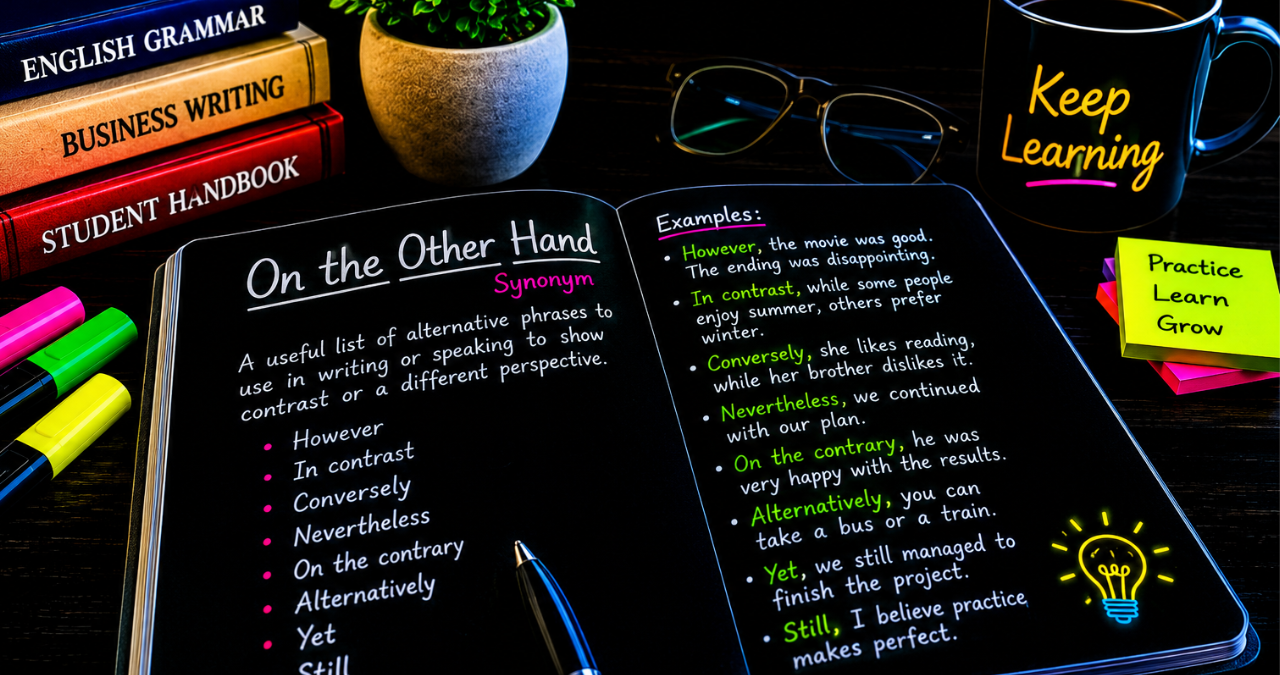

On the other hand synonym is a topic that many students, writers, bloggers, and professionals search for when they want to make their writing more interesting and less repetitive. The phrase “on the other hand” is useful because it helps readers see a different opinion, another choice, or an opposite idea. However, using the same expression again and again can make writing sound dull.
That’s where synonyms come in. A synonym is a word or phrase that has the same or a similar meaning as another word or phrase. Learning alternatives to “on the other hand” can improve essays, articles, emails, stories, and conversations. It can also make your ideas clearer and easier to understand.
In this guide, you will discover the meaning of the phrase, the best alternatives, examples of use, common mistakes, and practical tips to improve your communication skills.
Understanding the Meaning of “On the Other Hand”
The phrase “on the other hand” is used to introduce a different point of view or an opposing idea. It shows contrast between two thoughts.
For example:
- Traveling by car is convenient.
- On the other hand, flying is usually faster.
The second sentence presents another side of the discussion. This helps readers compare ideas before making a decision.
Writers often use this phrase in:
- School essays
- News articles
- Business reports
- Blog posts
- Speeches
- Everyday conversations
Because it appears so often, many people look for alternatives to keep their writing fresh.
Why Writers Need an On the Other Hand Synonym
Using the same transition phrase repeatedly can make content feel repetitive. Readers enjoy variety because it keeps their attention.
Benefits of using alternatives include:
- Improving readability
- Making writing sound professional
- Creating smoother transitions
- Showing a stronger vocabulary
- Keeping readers engaged
Imagine reading a paragraph where the same phrase appears five or six times. After a while, it starts to feel mechanical. A good writer knows when to switch things up.
That is why understanding an on the other hand synonym can become a valuable writing skill.
Best Alternatives You Can Use
There are many excellent replacements depending on the situation and tone of your writing.
Some are formal, while others are better for conversations.
In contrast
This phrase highlights differences between two ideas.
Example:
- City life is exciting.
- In contrast, village life is quieter and slower.
Conversely
This is common in formal and academic writing.
Example:
- Some people prefer working from home.
- Conversely, others enjoy the office environment.
However
One of the most popular transition words in English.
Example:
- The movie received excellent reviews.
- However, it did not perform well at the box office.
Nevertheless
This word introduces contrast while keeping the discussion flowing.
Example:
- The weather was terrible.
- Nevertheless, the event continued as planned.
On the contrary
This phrase is used when correcting or directly opposing an idea.
Example:
- He was not upset.
- On the contrary, he looked quite pleased.
Alternatively
Useful when presenting another option.
Example:
- You can travel by train.
- Alternatively, you can take a bus.
Yet
Short, simple, and powerful.
Example:
- The task was difficult.
- Yet the team completed it successfully.
Still
Often used in conversations and informal writing.
Example:
- The price was high.
- Still, customers continued buying the product.
A Helpful Table of Alternatives
| Alternative Phrase | Main Purpose | Formal or Informal | Example Situation |
|---|---|---|---|
| However | Show contrast | Both | Essays and reports |
| In contrast | Compare differences | Formal | Academic writing |
| Conversely | Present opposite ideas | Formal | Research papers |
| Nevertheless | Continue despite contrast | Formal | Business writing |
| On the contrary | Correct an assumption | Formal | Debates |
| Alternatively | Offer another choice | Both | Instructions |
| Yet | Show unexpected contrast | Informal | Stories |
| Still | Add a softer contrast | Informal | Conversations |
Choosing the Right Synonym for Different Situations
Not every alternative works in every sentence. Context matters.
For School Essays
Good choices include:
- However
- In contrast
- Conversely
- Nevertheless
Teachers often prefer these because they sound professional and clear.
For Business Writing
Strong options include:
- Conversely
- Alternatively
- Nevertheless
These words make reports and emails sound polished.
For Casual Conversations
Better choices are:
- Still
- Yet
- However
These feel natural and easy to understand.
For Debates and Discussions
Useful expressions include:
- On the contrary
- In contrast
- Conversely
These help explain different viewpoints effectively.
Examples That Show the Difference
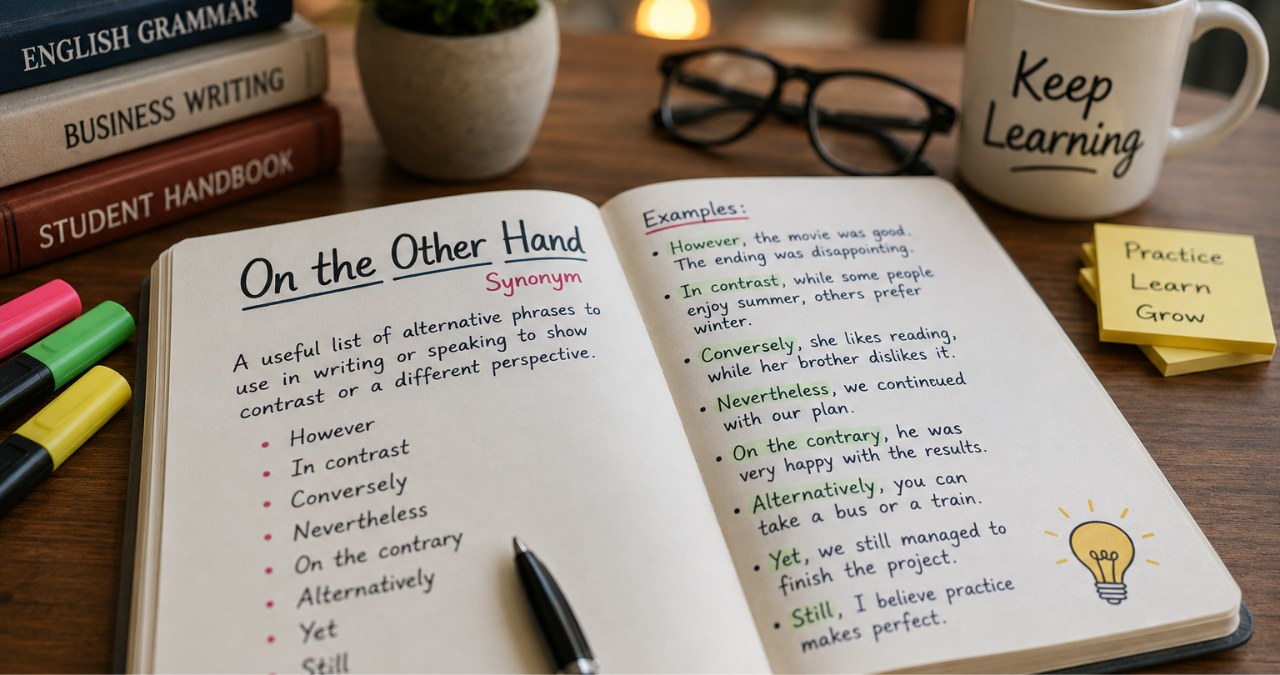
on the other hand synonym Seeing examples makes learning easier.
Example One
- Online learning offers flexibility.
- However, some students miss classroom interaction.
Example Two
- The laptop is lightweight and portable.
- In contrast, desktop computers usually offer more power.
Example Three
- The restaurant looked expensive.
- Still, the food quality justified the price.
Example Four
- Some people enjoy cold weather.
- Conversely, others prefer warm climates.
Example Five
- The project faced several delays.
- Nevertheless, the team delivered excellent results.
These examples show how each phrase creates a slightly different tone.
Common Mistakes People Make
Even experienced writers occasionally misuse transition phrases.
Here are some common mistakes.
Using the Same Phrase Too Often
Repeating one expression throughout an article can hurt readability.
Instead of writing:
- On the other hand…
- On the other hand…
- On the other hand…
Try mixing different options.
Using Formal Words in Casual Conversations
Imagine saying this during a friendly chat:
“Conversely, I disagree with your opinion.”
Technically correct? Yes.
Natural? Not really.
In casual settings, “however” or “still” often sounds better.
Choosing the Wrong Meaning
Some phrases have specific uses.
For example:
- “On the contrary” corrects an assumption.
- “Alternatively” introduces another option.
Using them incorrectly may confuse readers.
How Students Can Improve Their Vocabulary
Building vocabulary does not happen overnight. It grows little by little.
Students can improve by:
- Reading books regularly
- Learning new words daily
- Practicing writing exercises
- Watching educational videos
- Keeping a vocabulary notebook
Many successful writers develop the habit of collecting interesting words and expressions. Over time, these become part of their natural writing style.
The Role of Transition Words in Good Writing
Transition words are like bridges between ideas.
Without them, writing feels choppy.
Consider this example:
- The store was crowded.
- We entered anyway.
- We found what we needed.
Now add transitions:
- The store was crowded.
- However, we entered anyway.
- Eventually, we found what we needed.
The second version flows much better.
Transitions help readers:
- Follow ideas easily
- Understand relationships between thoughts
- Stay engaged
- Enjoy the reading experience
Great writing is not only about big words. It is also about connecting ideas smoothly.
How Professional Writers Avoid Repetition
Professional writers rarely repeat the same phrase again and again.
Instead, they use strategies such as:
- Replacing repeated expressions
- Changing sentence structure
- Combining short sentences
- Using varied transitions
- Reading their work aloud
Reading aloud is surprisingly effective. If a sentence sounds repetitive, chances are it needs improvement.
Many journalists and editors rely on this simple technique every day.
The Importance of Context
Words can change meaning depending on context.
For example:
“However” works almost everywhere.
“Conversely” is better for formal comparisons.
“Alternatively” introduces choices rather than disagreement.
Choosing the correct phrase is a bit like choosing the right tool from a toolbox. A hammer is useful, but not when you need a screwdriver.
The same idea applies to language.
Tips for Teachers and Parents
Teachers and parents can help children improve writing skills by encouraging vocabulary growth.
Helpful activities include:
- Word games
- Reading challenges
- Story writing exercises
- Vocabulary competitions
- Group discussions
Children often remember words better when learning feels fun rather than stressful.
A simple game today can become a strong writing skill tomorrow.
Technology and Modern Writing
Digital communication has changed how people write.
Emails, blogs, websites, and social media posts require clear and engaging language.
Because online readers often skim content quickly, writers need effective transitions to guide them.
Good transition phrases help readers:
- Move through articles smoothly
- Understand key ideas quickly
- Stay interested longer
- Remember important information
Even in the age of smartphones and short videos, strong writing skills remain valuable.
Fun Practice Exercises
Try these activities to improve your understanding.
Exercise One
Replace the phrase with another option:
- The hotel was expensive. On the other hand, it offered excellent service.
Possible answer:
- The hotel was expensive. However, it offered excellent service.
Exercise Two
Choose the best alternative:
- The city is busy. ________, the countryside is peaceful.
Correct answer:
- In contrast
Exercise Three
Write your own sentence using:
- Nevertheless
- Conversely
- Alternatively
Practice is the secret ingredient to improvement.
Final Thoughts on Expanding Your Vocabulary
Learning alternatives for common phrases can transform ordinary writing into engaging communication. Whether you are writing essays, preparing reports, creating blog posts, or simply chatting with friends, varied language makes a big difference.
The best approach is to learn gradually. Add one or two new expressions to your vocabulary each week. Use them in conversations and writing until they feel natural.
Language is a living tool, and every new word gives you more ways to express your ideas.
By understanding the meaning, purpose, and proper use of each alternative, writers can communicate with confidence and clarity. In the end, mastering an on the other hand synonym is not just about replacing words—it is about becoming a stronger and more effective communicator through thoughtful language choices and better expression of ideas using the right on the other hand synonym.